
When you drive down a road, you probably don’t think about what type of asphalt was used. But the type of mix plays a huge role in how long that pavement lasts, how smooth it rides, how it handles rain, and how well it stands up to truck traffic.
The Federal Highway Administration (FHWA) and the National Asphalt Pavement Association (NAPA) created a guide to help engineers choose the right Hot Mix Asphalt (HMA) for different situations. Here’s a plain-English breakdown of what it all means.
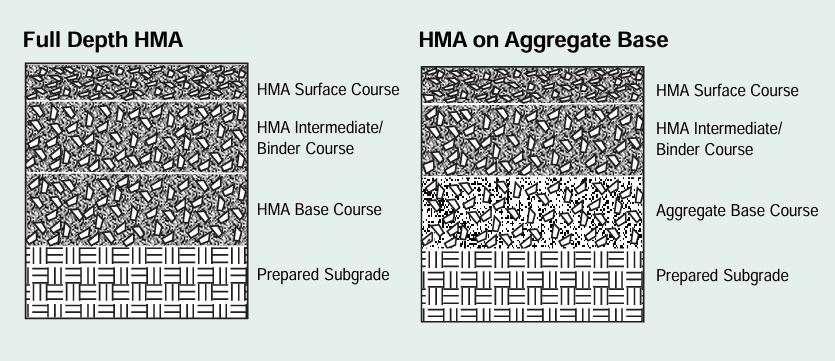
First: Roads Are Built in Layers
Asphalt pavement isn’t just one thick layer. It’s built in sections:
- Surface layer: The top layer you drive on. It provides smoothness, skid resistance, and protects the pavement below from water.
- Intermediate (binder) layer: The structural middle layer that helps distribute traffic loads.
- Base layer: The foundation of the asphalt portion. It provides the main structural support.
- Subgrade: The compacted soil underneath everything.
Each layer may use a different type of asphalt mix depending on traffic, climate, and cost considerations.
Traffic Matters More Than Anything
The guide classifies roads based on long-term traffic levels (measured over 20 years):
- Low traffic: Local roads, light-use streets.
- Moderate traffic: State routes, city streets, some highways.
- High traffic: Interstates, major highways, truck routes.
The heavier the traffic, especially truck traffic, the stronger and more rut-resistant the mix needs to be.
The Three Main Asphalt Mix Types
1️⃣ Dense-Graded Mixes (The Workhorse)
This is the most common asphalt mix used today.
Best for: Almost any layer (surface, binder, or base) and most traffic levels.
Why it’s popular:
- Strong and durable
- Cost-effective
- Relatively impermeable to water
- Works well for both new construction and overlays
Dense-graded mixes come in different aggregate sizes (fine or coarse). Smaller stone mixes create smoother finishes (great for city streets). Larger stone mixes resist rutting better (great for truck traffic).
2️⃣ Stone Matrix Asphalt (SMA)
SMA is considered a premium mix. It uses a stone-on-stone structure with higher asphalt content and often includes fibers or modified binders.
Best for: High-traffic roads and heavy truck routes.
Advantages:
- Excellent rut resistance
- High durability
- Good wet-weather friction
- Often quieter than traditional mixes
Because of its higher material cost, SMA is typically used on interstates or major highways where performance justifies the investment.
3️⃣ Open-Graded Mixes
Unlike other mixes, open-graded asphalt is designed to let water pass through it.
There are two main types:
Open-Graded Friction Course (OGFC)
- Used as a surface layer
- Reduces splash and spray during rain
- Improves wet-weather safety
- Can reduce tire noise
Asphalt Treated Permeable Base (ATPB)
- Installed below the surface
- Designed to improve drainage under the pavement
These mixes work best on higher-speed roadways. They require proper drainage planning and shouldn’t be used everywhere.
Choosing the Right Mix: It’s About Balance
The guide explains that mix selection depends on:
- Traffic volume and truck percentage
- Speed of traffic
- Climate conditions
- Existing pavement condition (for overlays)
- Budget
- Desired surface performance (smoothness, friction, noise reduction)
For example:
- A downtown street may use a smoother fine-graded mix for appearance and ride quality.
- An industrial park with heavy trucks may use a coarser, more rut-resistant mix.
- A major interstate might use SMA for durability, topped with OGFC for improved wet-weather performance.
Proper Preparation Is Critical
No matter which mix is chosen, performance depends heavily on:
- Proper compaction of the subgrade
- Adequate drainage
- Milling and repair before overlays
- Correct lift thickness (too thin = premature failure)
Even the best mix will fail if installed incorrectly or placed over a weak foundation.
The Bottom Line
There is no “one-size-fits-all” asphalt mix.
Dense-graded mixes handle most applications.
SMA is ideal for heavy traffic and long-term performance.
Open-graded mixes improve drainage and wet-weather safety.
The key takeaway from the FHWA and NAPA guide is simple:
Match the mix to the traffic, environment, and structural needs, not just the price per ton.
When the right mix is chosen and installed properly, pavement lasts longer, performs better, and saves money over its lifecycle.
